
Campus Scout
A family housing emergency turned into a working product, built solo in spare hours
The problem
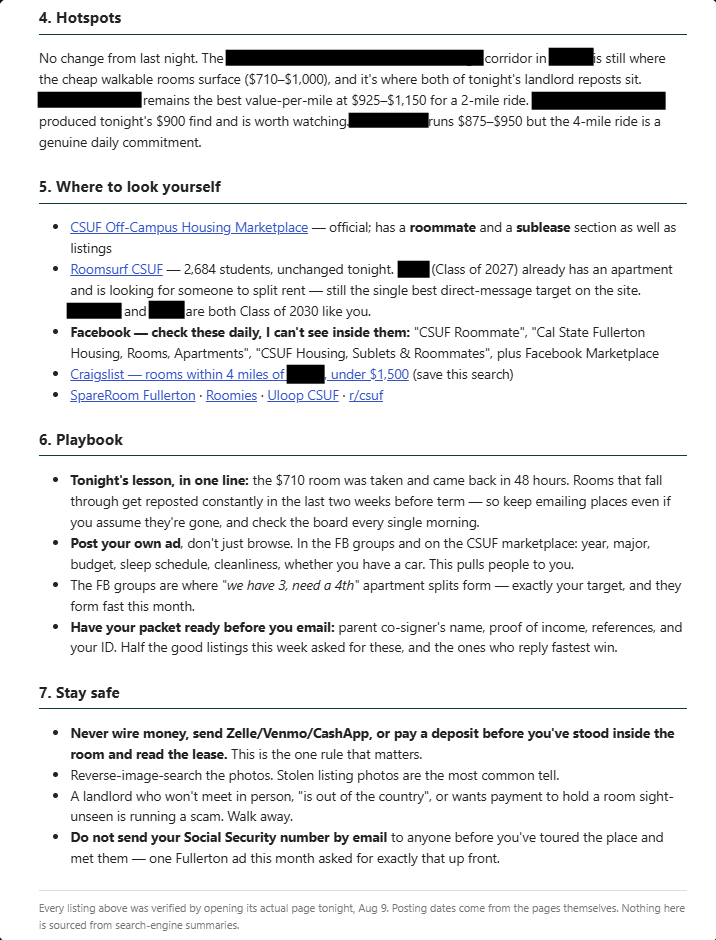
An incoming freshman in my family had about a month to find off-campus housing near Cal State Fullerton. If you haven’t looked at student housing lately, it’s rough. Listings are scattered across university marketplaces, Craigslist, roommate platforms, and Facebook groups. There’s no good way to rank them against a student’s actual constraints, like budget and bike distance to campus. And scammers target students specifically. Renters aged 18 to 29 are three times more likely to lose money to rental scams, with $65M in reported losses in 2025.
I didn’t start with a pitch deck. I started by fixing the problem in front of me.
The prototype (in production since July 2026)
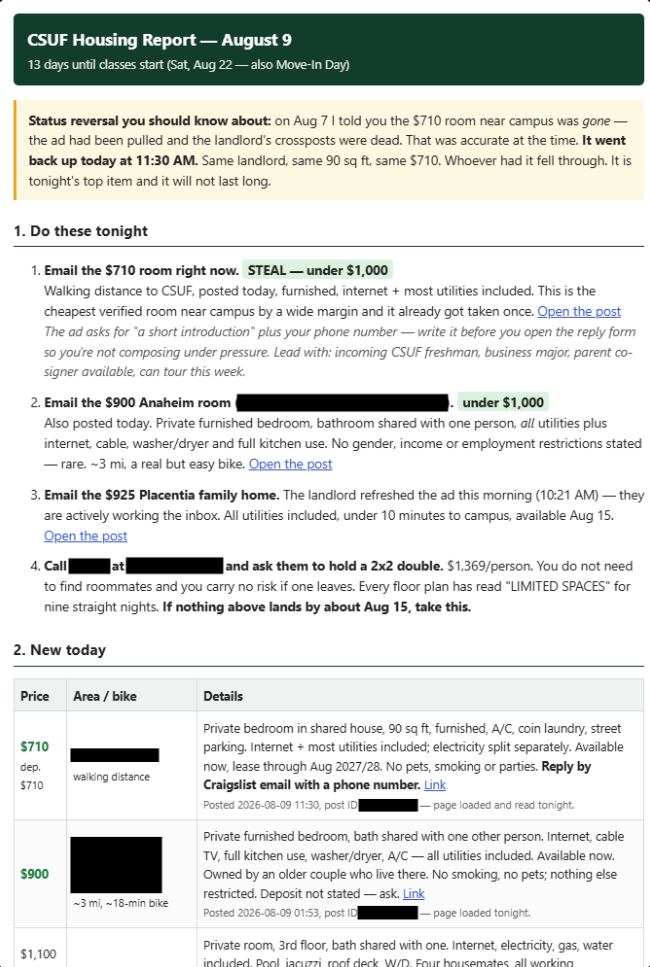
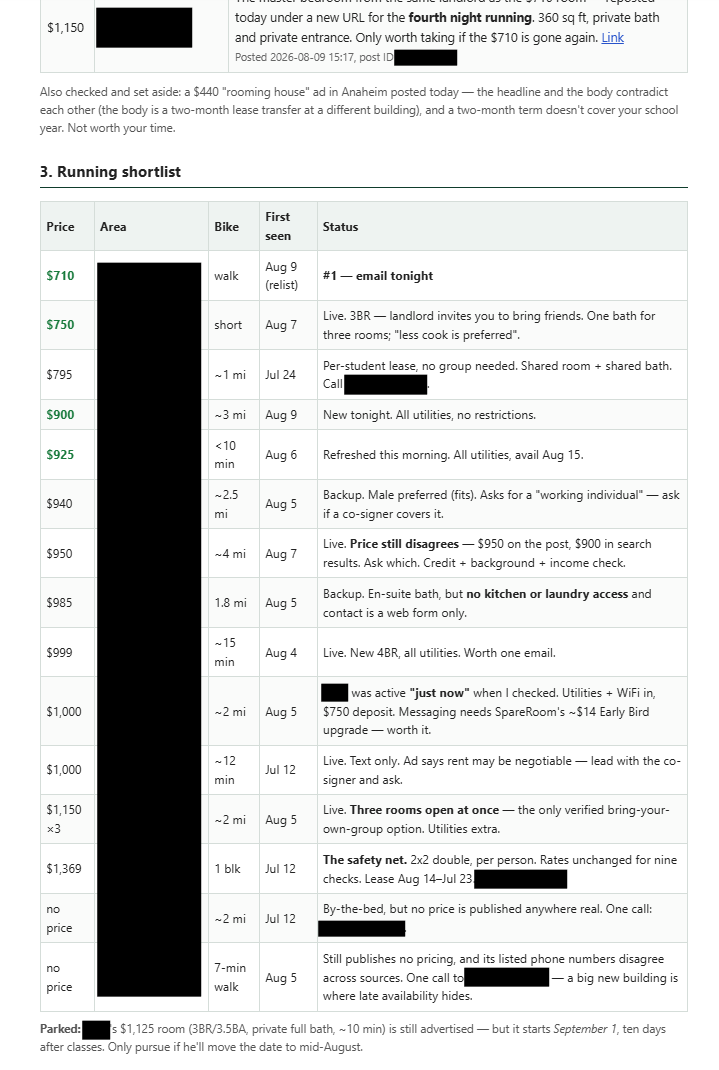
Using Claude Code, I built a nightly housing scout. Every evening at 8pm it sweeps every relevant source, removes duplicates, verifies each listing is still live, scores scam risk, ranks everything by bike distance and budget fit, and emails a report with a running shortlist and ready-to-send outreach drafts.
It has one user, the family member it was built for, and it works. The verification pass has caught wrong phone numbers and fake-cheap listings before a real person acted on them.
The PM work: is this a product?
A working prototype isn’t a business, so I scoped it like one. I ran three research passes (competitors, infrastructure, and California law) and pulled them into a full scoping report covering the market, unit economics, pricing, and revenue scenarios. Three findings shaped everything.
1. The law flipped the monetization in my favor
California’s Prepaid Rental Listing Service law makes charging renters for listings a licensed activity. You need a DRE license and a $10,000 bond, and operating without them is a misdemeanor. This is why Zillow and Apartments.com are free for renters.
So the product inverted. Listings became the free tier, which doubles as the marketing engine: a free weekly digest for each campus. The paid tier sells the tools around the listings instead. Personalization, outreach drafting, application tracking, scam screening. The statute explicitly exempts those. The legal constraint and the growth strategy turned out to be the same design.
2. One architecture decision makes the economics work
Web searches dominate the AI bill. A naive per-user nightly sweep costs about $2.40 per user per month. The plan instead researches once per campus and shares that cost across every subscriber at the school, then personalizes each report from the cached digest with a cheap model. That drops the marginal cost to roughly $0.45 per user against a $19 subscription, and the whole stack costs about a dollar a month at zero users.
3. Seasonality is the business model
Student housing demand comes in two windows a year, and a successful customer churns because they signed a lease. Instead of fighting that with an annual subscription, the plan sells a $39 season pass that doesn’t auto-renew. Churn by success. Returning students buy again, and non-renewing pricing sidesteps California auto-renewal law entirely.
Decisions I’d defend in an interview
| Decision | The tradeoff I accepted |
|---|---|
| Listings free, tools paid | Gave up the obvious revenue line to stay outside a licensing regime, and got a free growth engine in exchange |
| Research per campus, personalize per user | More pipeline complexity for a 5 to 8x drop in marginal cost |
| Free self-serve beta instead of a concierge pilot | Slower validation signal, but a real product to iterate on |
| Defer the LLC until revenue is close | California’s $800 a year franchise tax isn’t justified for a free product. The formation triggers are written down, not forgotten |
| Never scrape | AI web search with citations, linking out to the source. Thinner data, but it avoids the pattern that ended in a $3.1M settlement for Padmapper |
| Gender preference exists only for shared-living listings | The Roommates.com fair-housing rulings constrained the matching design, so the architecture enforces the rule instead of trusting the UI |
Where it stands
- Live: the nightly prototype, in daily use by one real user
- Done: the scoping report, legal analysis, decision log, and a phased roadmap with written exit criteria
- Next: a landing page and a small free beta at CSUF
- Deferred on purpose: payments, the LLC, insurance, more campuses
What this shows
Problem discovery with real stakes. A working prototype instead of a mockup. Regulatory analysis that reshaped the product instead of blocking it, and unit economics down to the per-user cost. Everything referenced here exists.