
AI Workstation
One Claude setup every ArborXR employee can start from, built at our AI-a-Thon
The problem
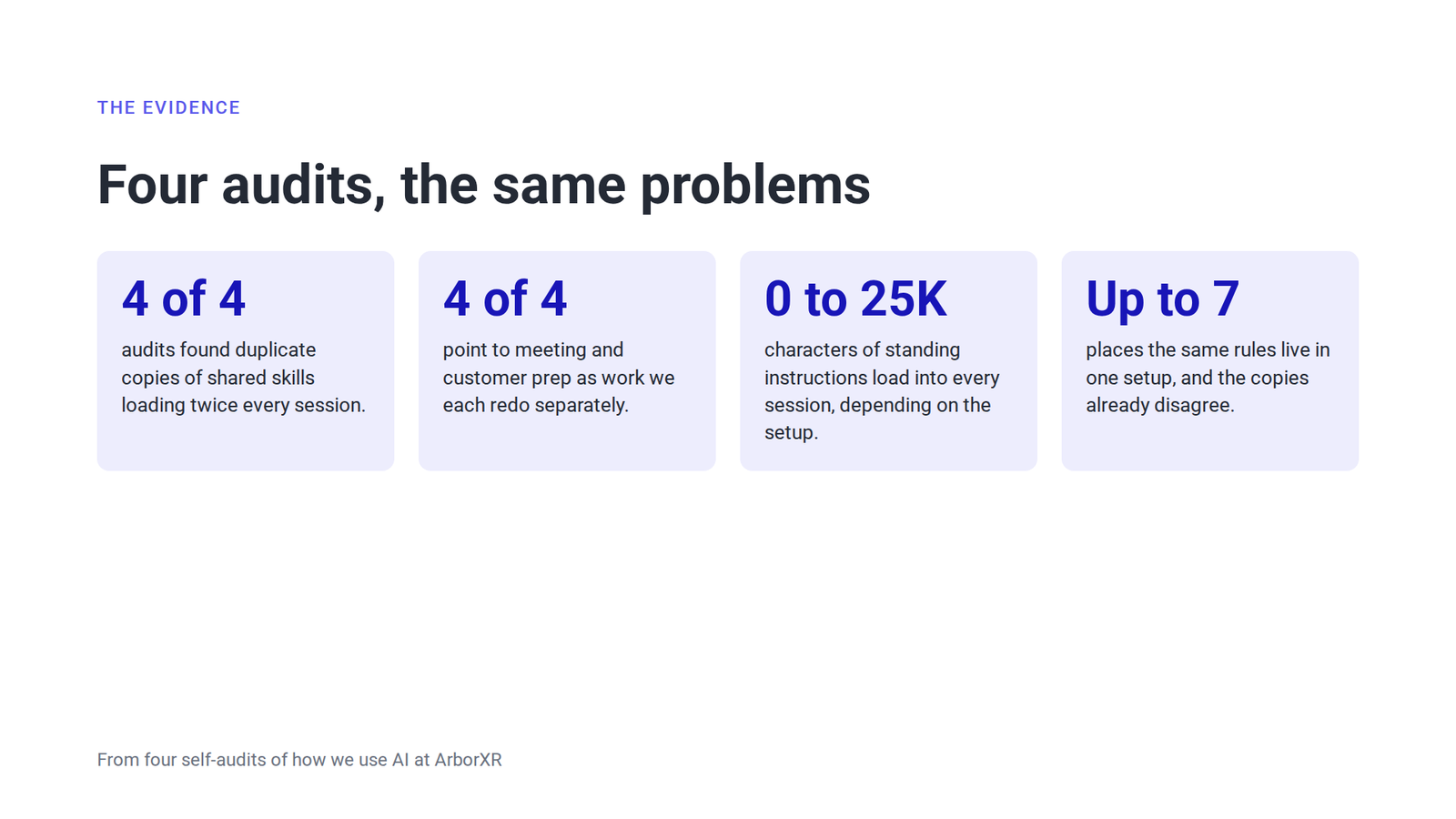
A lot of work at ArborXR runs through Claude, and the people who were good at it had each built their own setup alone. None of it was shared. Rules got pasted into memory, instruction files and task prompts until the copies disagreed with each other. Shared skills got installed twice. Anyone new started from zero.
Our company held an AI-a-Thon in September 2026, and the goal was to ship one real thing that helps the team. I wanted to give everyone the same clean starting point.
To avoid guessing at what was wrong, four of us audited our own setups first. The same problems showed up in all four.
What I shipped
Two skills in the company’s shared Claude plugin, so they reach everyone automatically, plus the written standard behind them.
The first is workstation-setup. You start it by telling Claude “set up my ArborXR workstation”, and it walks you through nine short steps in four stages. It connects the nine tools we all use, clears out duplicate skills and bloated instructions, and builds two personal skills. One knows your role, your people and your projects. The other writes like you. Claude drafts both from your own calendar, Slack and sent messages, so you mostly click to confirm. It ends by showing you everything you got, and “tune up my workstation” runs it again later.
The second is second-opinion. Before an important customer email or leadership doc goes out, a different model reviews it. The reviewer only sees the work, so it isn’t biased toward something it just wrote.
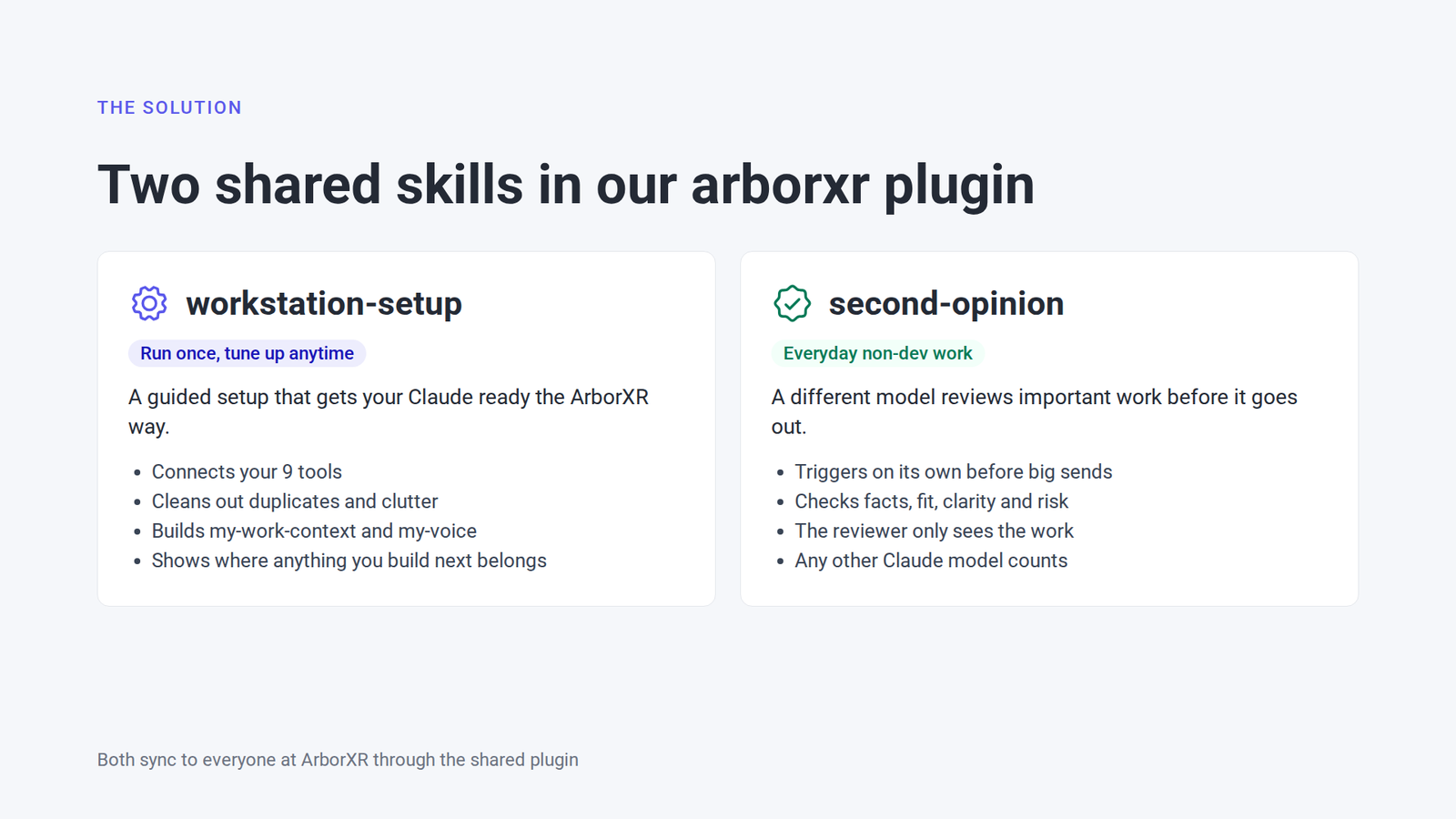
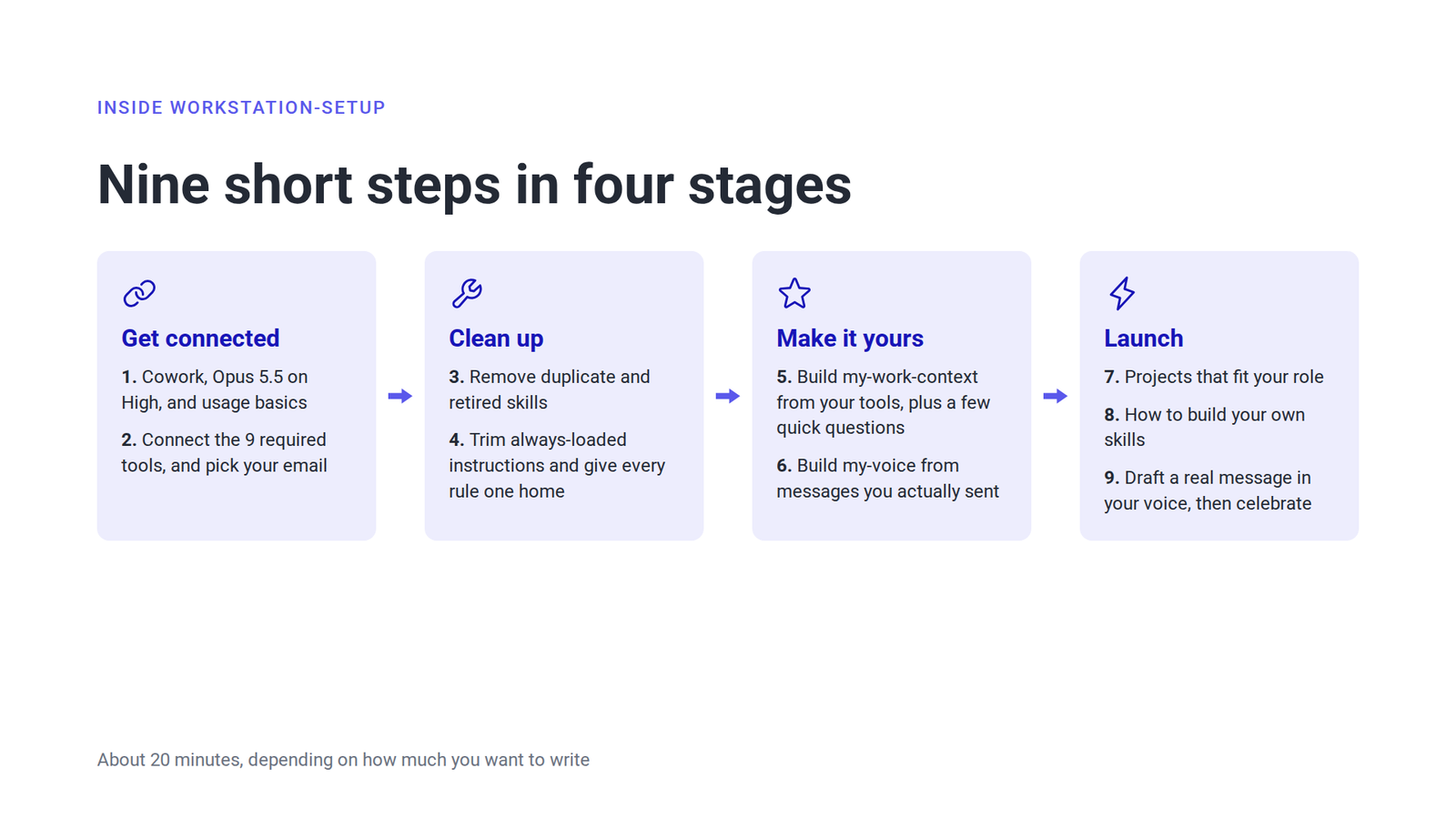
These screenshots are slides from the deck I presented at the AI-a-Thon, re-rendered for this page. I took coworker names off one of them.
How I built it
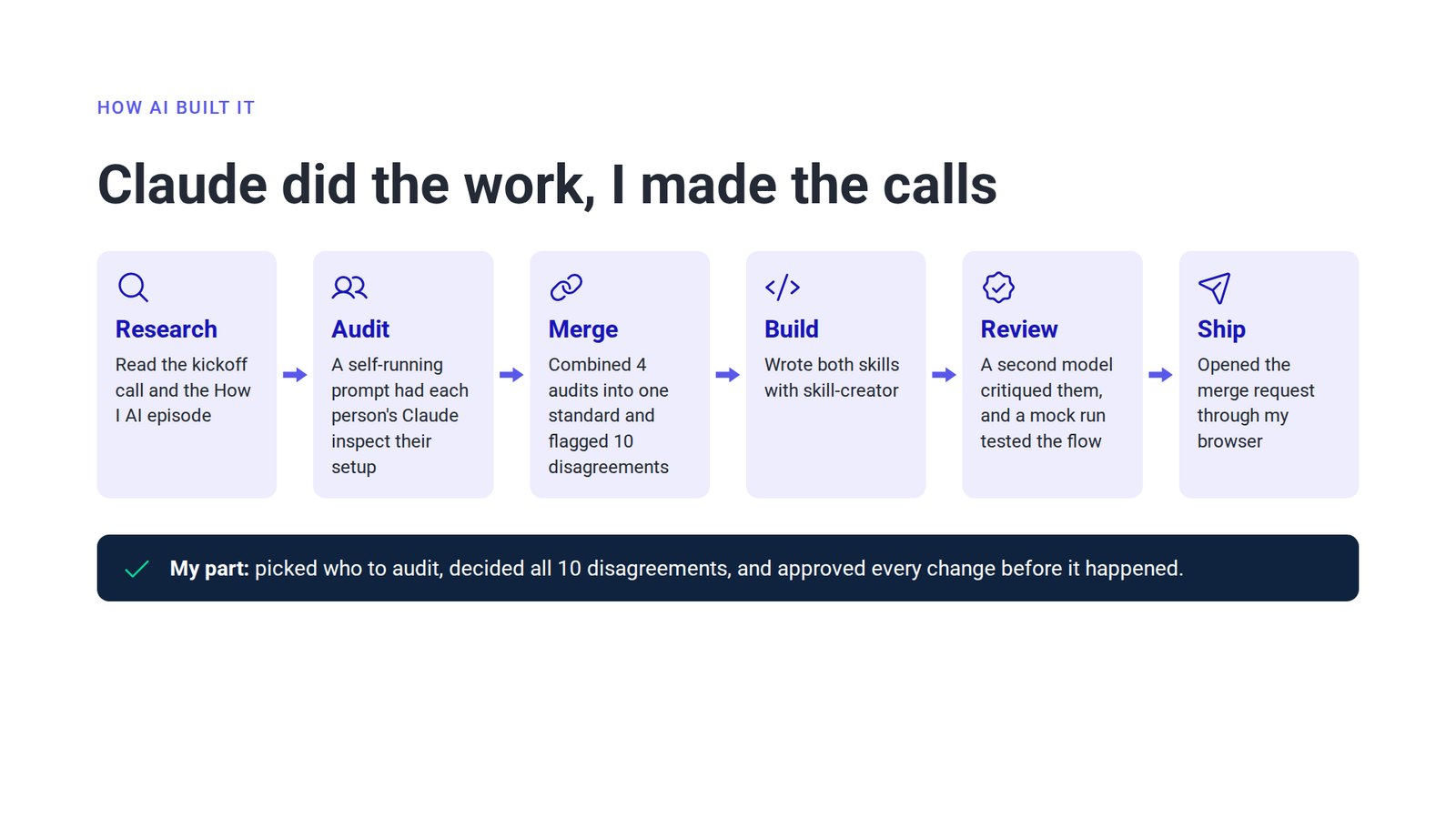
I directed Claude (Opus 5.5, in Cowork) through the whole thing. Most of it happened on the day of the AI-a-Thon, and it went live four days later.
- Read the kickoff call’s best practices and a podcast episode about how another company onboards its team to Claude.
- Wrote a self-running audit prompt. Four of us gave it to our own Claude, and it wrote up exactly how each of us works.
- Merged the four audits into one standard and pulled out the 10 places where we disagreed. I decided all 10 myself, using the kickoff’s best practices as the tiebreaker.
- Built both skills with Anthropic’s skill-creator, had a different model critique them, and ran a mock onboarding to find where it would stall.
- Opened a merge request in our shared skills repo. Claude did it through my own browser session.
- Ran it on myself. It asked too many open questions and the ending fell flat, so I reworked it to draft first, ask click-to-answer questions, and finish with a real celebration.
- The engineer who owns our shared skills repo reviewed it. He pointed out that engineers ask for code reviews many times a day, so I scoped second-opinion to non-engineering work. He merged it on September 29.
Decisions I’d defend in an interview
| Decision | The judgment behind it |
|---|---|
| Package it as skills | Instruction files load into every session and keep growing. A skill loads only when it’s needed and works in every Claude app, so personal context lives in personal skills |
| Same base for everyone, with no forced automations | Everyone gets connected tools and a clean setup. Nobody gets a daily routine they didn’t ask for, because people build different things |
| Make voice the one required step | Tone was the correction people made most in the audits, so a Claude that already writes like you pays off on day one |
| Draft first, then ask | My own first run felt like a slog. Now Claude reads your tools and drafts everything, and it asks at most three click-to-answer questions at a time |
| Settle the disagreements myself | I’d planned a meeting for the 10 disagreements. I decided them myself instead, with the kickoff’s best practices as the tiebreaker, because the point of the day was to ship something people could use |
| Keep the review skill out of code | Engineers review code many times a day, and a second-model check on every one of those would just be noise |
| Drop the projects nobody would maintain | I’d planned two shared Claude projects to go with it. The skill already carries the standard, so a project would have been one more copy to keep in sync |
Where it stands
Live for everyone at ArborXR since September 29, 2026. I announced it in our AI channel, and the first coworker to run it was done in about 15 to 20 minutes, with their tools connected, a few duplicate skills gone, and both personal skills built from their own Slack and support messages. Next I want to watch a few more people run it from zero, and build the shared skills the audits pointed to, starting with post-call summaries from Fathom.